
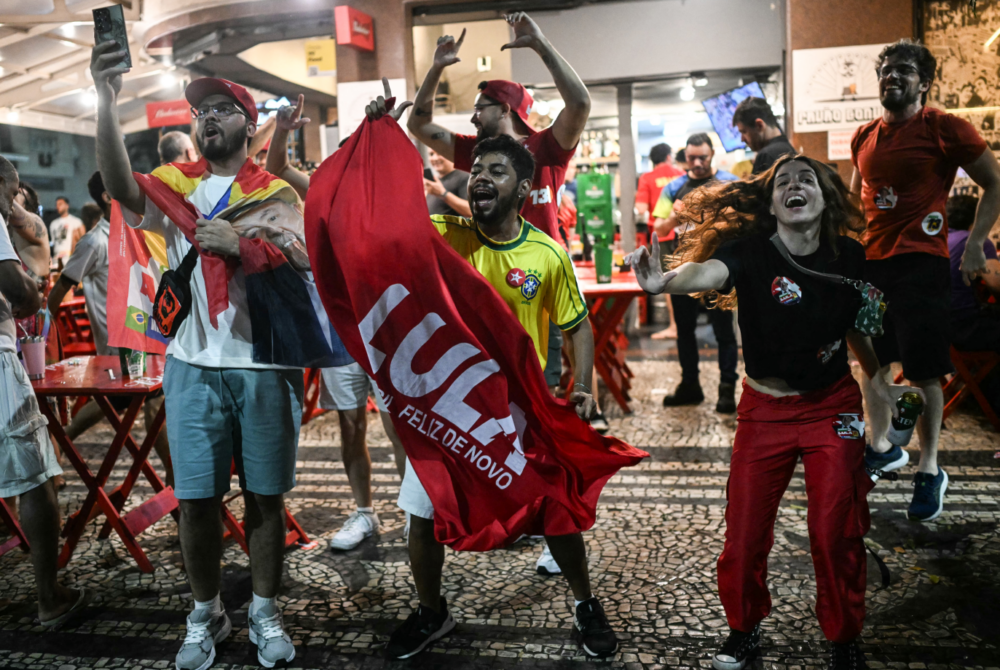
Brazil did not ultimately swing to the right like Argentina, Chile or Colombia, all backed by the U.S. President Donald Trump. It remains one of the few progressive strongholds in Latin America.
With 51.76% of the votes against 48.24% for conservative senator Flavio Bolsonaro after nearly complete tallies, the veteran defied all forecasts.
He had been edged in the first round by the son of former far-right president Jair Bolsonaro (2019-2022).
“I am very moved. This is a historic victory for President Lula. The people mobilized, came together,” said to AFP Mariana Andrade, a 33-year-old lawyer who followed the tally on a giant screen in downtown Rio de Janeiro.
In this fourth term, the president’s room for maneuver appears limited after the conservative landslide at the legislative elections three weeks ago.
The campaign has shown how divided the country remains, and a controversy even disrupted election day.
By order of a Supreme Court judge, the vote was extended by two hours, after an appeal from Lula’s campaign team.
Declaring “an abominable thing,” the outgoing president claimed that voters had been “prevented from voting.” According to him, buses were taken off the roads in cities like São Paulo (southeast), led by a right-wing mayor, or Salvador de Bahia, in his Northeast stronghold.
Social Measures
On a personal level, Lula’s re-election crowns an extraordinary journey. And a final nod to fate for the former poor boy from Pernambuco (Northeast).
He already held a record: no democratically elected president has governed Brazil for so long.
The one who is already one of the world’s oldest leaders will be 85 at the end of his new term in 2030. He will thus total 16 years in power, after a first presidency from 2003 to 2010.
A stainless-veteran in an era of anti-establishment sentiment, Lula has warded off the wear of time and a strong fatigue toward his Workers’ Party (PT).
The PT remains associated by many with the scandals that tarnished it in the 2000s.
Its leader himself experienced the stigma of a corruption conviction that earned him 580 days in prison in 2018-2019, before being overturned for procedural reasons.
To turn the score, the international left icon multiplied in the final stretch the popular and often costly measures.
The first Brazilian president from the working class notably boosted Bolsa Familia, his flagship social program aimed at the poorest families.
Defence of the Flag
During his campaign, Lula waved the banner of sovereignty in the face of commercial and diplomatic pressure from the United States.
Voters must “choose a country where the flag is respected,” he said in a tired voice after voting, accusing his rival of wanting to “govern with the American flag.”
Donald Trump, however, refrained from offering explicit support to Bolsonaro’s son. Asked Sunday about the election, the American president simply said: “We are watching.”
But it was Meta that in the final days faced attacks from the left. The parent company of Facebook, WhatsApp and Instagram was accused by Lula’s team of “interference” and of favoring Flavio Bolsonaro on its platforms.
The American tech giant denied any bias but acknowledged “technical problems” that had penalized the left’s campaign on its platforms.