
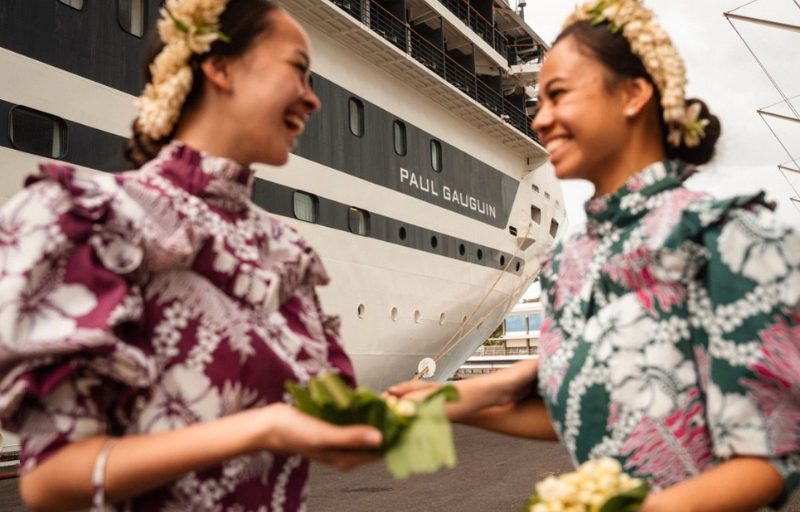
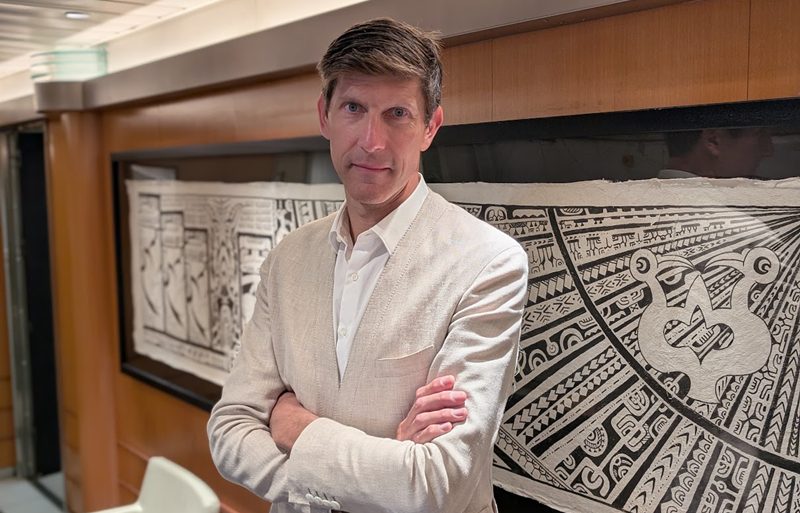
The CEO of Ponant Explorations Group, Benoît-Étienne Domenget, visited the fenua a few days ago. It was an opportunity to confirm the Jacques Cartier’s return each summer season, which has begun cruising the archipelagos, in addition to the Paul Gauguin. It was also a chance to reaffirm that the luxury cruise specialist intended to invest in a “very solid destination.” Not through luxury catamarans, as had been announced last year, but by leveraging, through its global network, to diversify the tourist clientele. Ponant, which recognizes the potential of the Australian market, also aims to capitalize on the opening of the ATN route to Sydney.
“The Polynesians will have to get used to seeing the Jacques Cartier; it will return every year for five months, during the summer.” From the deck of the Paul Gauguin, also linked to Ponant Explorations, Benoît-Étienne Domenget expresses pleasure at the development of his group’s offering in the fenua. The CEO, who flew out at the end of last week, spent several days conducting meetings with local partners and institutional officials. With the same message: Ponant is “here to stay” on a destination that the luxury cruise group intends to help develop.
“Thus, the five-month Polynesian season of the Jacques Cartier, which recently, for the first time, passed through Hiva Oa last week with around 140 passengers, should be repeated every year, confirms the leader. With diversified itineraries: Austral Islands, Gambier, Marquesas in addition to the “classics” at Raromatai and the Tuamotu… This “explorer ship” of luxury offers longer stays, around 14 days, compared with 7 to 10 on the Paul Gauguin, in order to “offer the possibility to continue to roam, to discover the entirety of the possibilities, all the potential and richness of Polynesia.”
“A favorable alignment of the planets”
And despite the few signals, which, after three years of sustained activity, worry some local tourism professionals, Domenget nonetheless sees significant development potential for the destination. Notably with the opening of Air Tahiti Nui’s route to Sydney, whose first flight is scheduled for December 14. “A very good news for tourism in Polynesia,” explains the executive, who already knows, on the mainland, the very attractive Australian clientele eager for discoveries, who enjoy getting off the beaten path and love the concept of exploration. In March next year, the company already plans, in Australia, “promotion activities with local partners here, Tahiti Tourisme and Air Tahiti Nui, to show not only the Jacques Cartier, which our passengers know well, but also the entire Polynesian destination to these new markets.”
Beyond this new potential clientele, the CEO salutes the work of local tourism players, particularly in terms of infrastructure and connectivity. “there is a beautiful alignment of the planets between today’s tourism vision and tomorrow’s in Polynesia: the support for the players, the willingness to internationalize, to keep growing… JI want to commend the work done on infrastructure, the ability to connect Polynesia, tomorrow from Australia and China, from Japan andthe United States of course, and from Europe for a long time. I also want to commendthe work done more locally to serve these 48 airports, as well as that ofhotel partners, who invest and continue to invest regularly. This entire value chain helps make Polynesiaa solid destination.”
“The highest satisfaction rate is in Polynesia”
The Ponant group therefore states that it intends to profit from its global network for Polynesia. And as proof, a cruise organized a few days earlier aboard the Paul Gauguin for Virtuoso, a specialist in ultra-high-end travel. Travel agents from around the world — “Australia, China or Switzerland” — were able to discover the country, and the feedback was “obviously excellent, both for the destination and the quality of the onboard experience.” For Benoît-Étienne Domenget, these very positive returns are “not a surprise”: “Ponant Explorations, the highest satisfaction rate is in Polynesia.”
According to him, the recipe lies in a fairly unique combination between what happens aboard for our passengers and the quality of all the activities they can undertake on shore. For the CEO, there is no doubt that Polynesia has what it takes to “diversify its audience.” . “North American clientele has a historical taste and appetite for Polynesia, and you don’t see this movement decline, quite the contrary.” But we strongly believe in developing a clientele that is still fairly new to Polynesia.
I first think of the Australian clientele, butalso of Asia and China, which are emerging markets for Polynesia.And there is the return of Europeans, who love Polynesia a great deal. That market exists and is consolidating,and the ability to offer, with the Jacques Cartierand the Paul Gauguin, different itineraries will contribute to the development of the destination, we are convinced.”
The Ponant group does not currently plan to base or deploy a third vessel in Polynesia. The idea of sailing private luxury catamarans there, which had been announced under the Ponant Yachting label last year, seems to have been put aside. And the Spirit of Ponant II, which was to be destined for Tahiti by the end of this year, will not be delivered there. Not in the “DNA” of the group, the CEO notes, who nonetheless confirms that the Swap2Zero project, a carbon-free cruise ship, remains “still on the agenda.” “French Polynesia is among the regions where we could deploy it,” Olivier Narcy, the company’s sales director and regional head, stated in January.
Although this grandeur project remains “close to the heart” of the CEO because it reflects his “commitment to responsible and sustainable tourism,” it must be noted that it is stalling. The reason: “inboard technologies are highly innovative,” but still “at relatively modest levels of maturity.” These “very beautiful concepts” are only just beginning to be deployed, with “relatively little feedback,” and the group will invest only when they become economically viable.
Added to this are rising construction costs, which “have risen very significantly over the last five to ten years,” due to a “limited availability of shipyards,” which are “globally at a saturation point.” There is “no announcement to make today,” but Benoît-Étienne Domenget assures: “It is a topic that is by no means being sidelined. Ponant has been in Polynesia for 30 years; we have been here for a long time and for a long time to come.”