
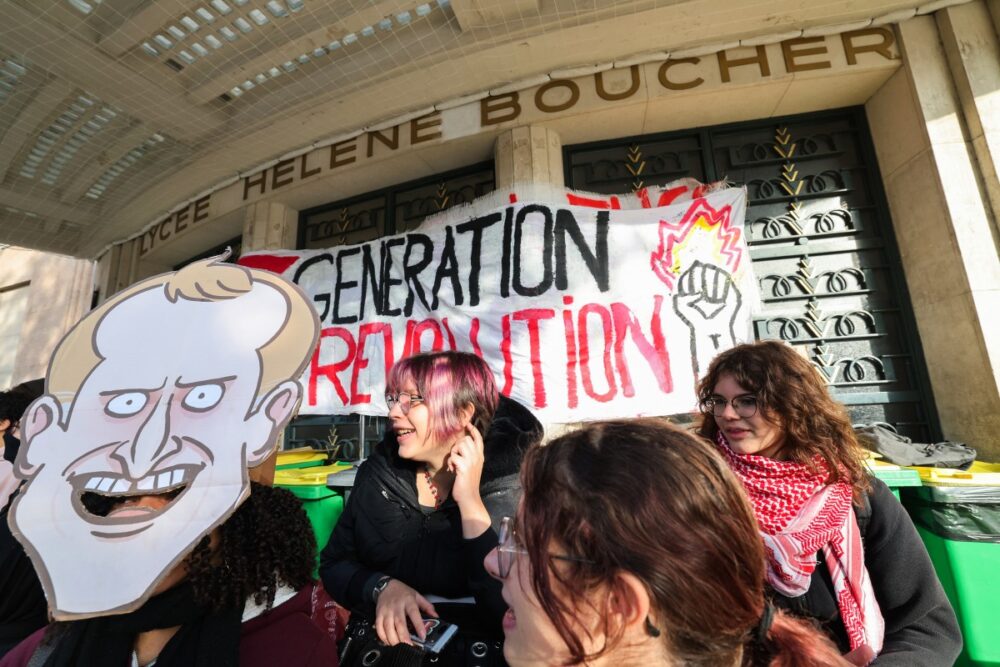
At 9:30 a.m., 41 institutions were blocked, accounting for a little over 1% of the roughly 3,700 institutions in France, according to the ministry’s figures. “That’s essentially quite residual (…),” commented on France Inter Education Minister Édouard Geffray. An assessment strongly contested by the Lycéenne Union Syndicale (USL), which says it counted 150 establishments blocked on Monday.
Around 15% of higher education institutions have experienced “disruptions” of varying degrees: “a building that was blocked at some point during the day,” or “one or two laboratories that could not operate,” for example, said the supervising minister Philippe Baptiste on LCP.
And the movement is expected to grow this week, with a call to block universities and high schools on Tuesday. This “will be a dark day for the universities,” warned the Unef even before the weekend.
“The anger goes on. We don’t feel at all that it’s winding down,” says Coppélia Moreau of Interfac Île-de-France, who presents herself as the general assembly of students from the faculties in the Île-de-France region.
The collective wanted to demonstrate on Tuesday between the Panthéon and the MeDEF headquarters, but the prefecture vetoed the plan and proposed a route on the outskirts, between the Charenton and Montreuil gates.
Declining this alternative route, the collective plans to take the Administrative Court.
Dumpsters and Fences
In Marseille, seven high schools were blocked on Monday, out of the city’s 75 educational establishments, according to militant high-school students.
In the city center, the entrance to Montgrand High School was blocked in the morning by several garbage dumpsters piled up in front of the gates.
Last week, the government announced a series of measures aimed at ending the movement that began in mid-September.
Education and Higher Education ministers notably promised the gradual replacement of Parcoursup by 2028, the reversal of planned staff cuts in the National Education system, the creation of 500 additional positions, a cap of 28 students per second-year class, and 15,000 additional places in higher education.
A “first step” deemed insufficient by youth organizations, all of which called for continued mobilization.
Prime Minister Sébastien Lecornu reiterated his willingness to meet with the high-school representatives “next week.”
Crumbs
“There have been measures perhaps, some that may be acceptable, others that are ridiculous,” said Pia, 17, a terminal-year student at Condorcet High School in Paris, who was also blocked Monday morning.
Other attempts or blockades occurred in the capital, including at Hélène-Boucher or Honoré de Balzac.
The inter-union group comprising the Lycéenne Union Syndicale (USL), Unef, Fage and the Union étudiante is demanding a €10 billion investment in education and higher education, as well as the repeal of Parcoursup.
In Toulouse, at least seven institutions were blocked, AFP noted.
“It isn’t two government announcements that will be outdated in a few months that will stop the movement,” said Anton, 17, a student at Berthelot High School, to AFP.
In Lyon, the Rhône prefecture counted 15 establishments with crowds at the entrance and another that decided to conduct classes remotely.
In front of Ampère High School, the blockade was brought to a halt by the CRS riot police, calmly.
Authorities also carried out an arrest in the Lyon suburbs for mortar use.
A Year at Risk
“The absolute priority… is that the students can go to class. I have students taking the baccalauréat at the end of the year, and for hundreds of thousands of them they haven’t had classes for 4 or 5 weeks (…) and, consequently, the school year is now at risk,” warned Édouard Geffray.
On the ground, some students are beginning to voice their concerns.
“Honestly, it would be nice to get back into a rhythm, even a little,” said Ferdinand, a first-year student in Lyon, who is worried about a backlog to catch up with tests.
“I support the movement and its demands, but this is rough; it’s been a month without classes,” testified a 14-year-old second-year student in front of the Arènes High School in Toulouse, blocked by around a hundred youths.
Headteachers themselves were anxious about the return: “no one knows what to expect, everyone is on edge,” commented Agnès Andersen, general secretary of the ID-FO union representing school principals, the day before the new school year.