Hundreds of bodies had been found in 2023 in the inland area near Malindi’s beaches on the Kenyan coast, in a disaster quickly dubbed the “Shakahola forest massacre” by Kenyan media, one of the worst tragedies linked to sectarian drift that has traumatized the East African country.
Last month, the port city of Mombasa’s court on the Indian Ocean judged the self-styled pastor and former taxi driver Paul Mackenzie, along with 28 accomplices, guilty of the killings of 190 children and one adult between January 2021 and September 2023.
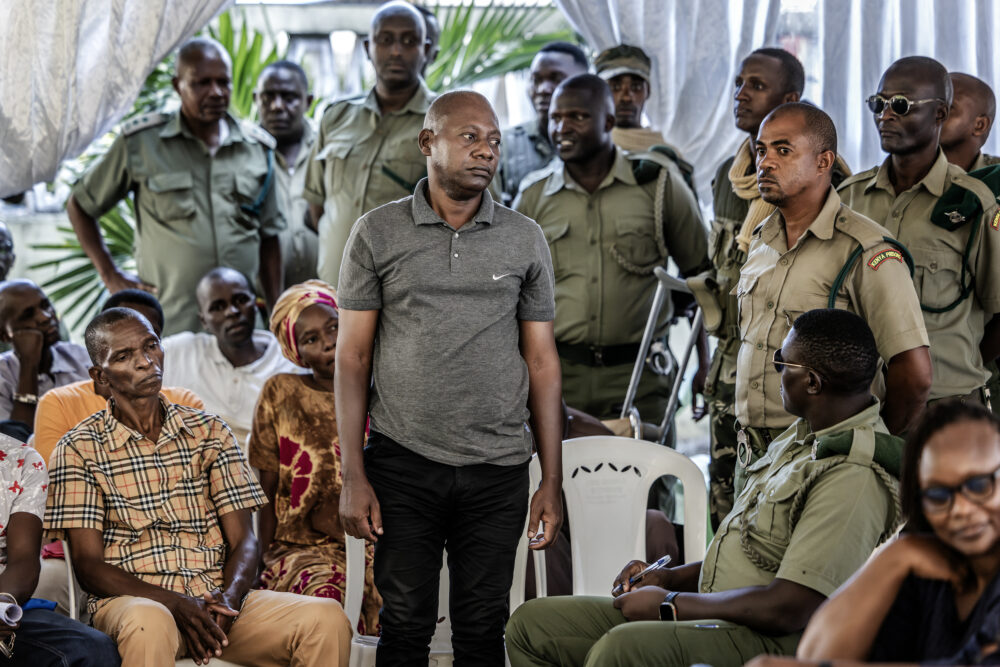
Mr. Mackenzie, wearing a gray polo shirt, remained impassive at the moment his sentence was read: 200 years in prison.
Several of his 28 co-defendants had starved their own children, prevented others from fleeing, and dug the graves of the deceased. Most of the accused later showed no remorse.
Twenty-six were sentenced to terms ranging from 100 to 160 years in prison, while two received 10-year sentences.
Prosecutors had requested the death penalty for the guru at the start of the week, a provision in Kenyan law, but one that has not been carried out since 1987.
While survivors said, “at Shakahola, death was celebrated as a marriage with Jesus (…) a death sentence could be experienced not as a punishment but as a triumph and a form of martyrdom,” the judge Diana Kavedza Mochache explained why she opted for prison terms.
“Children saw their siblings die before their eyes, (…) were beaten and endured atrocious agony while their parents ate and drank. Some died by strangulation. Others were severely beaten,” the magistrate added, noting that Mackenzie had transformed his followers’ trust into “a weapon of total control.”
“Nothing in the sentence can ease the pain I feel after losing my own,” reacted Francis Wanje, a 62-year-old retired teacher whose daughter, son-in-law and two grandchildren perished in the tragedy, to AFP.
Hierarchy of Death
Another one of his grandchildren, now 11, had reportedly fasted for eight days before being rescued in March 2023, according to court documents. His brothers aged 2 and 5, he testified, died after their parents were forbidden to drink or eat, on the guru’s orders.
If Mr. Wanje hoped for the death penalty for the latter, he consoled himself by saying, “at least the victims have obtained something.”
Defense lawyer Lawrence Obonyo told AFP that his clients would appeal, denouncing the verdict as “to satisfy the public.”
Mr. Mackenzie, who also faces separate proceedings on charges of “involuntary homicide” and “terrorism,” had “led” the practice of fasting under a “hierarchy of death,” according to testimony: children first, then teenagers, then women, and finally men.
During the trial, witnesses described a movement that rejected formal teaching as “satanic,” viewed modern medicine and hospitals as tools of the devil, and demanded that followers withdraw from the world in a Shakahola ranch, a vast stretch of Kenyan coast bush.
The guru was arrested in April 2023 after some disciples were rescued when a human-rights group alerted authorities. The police operation uncovered mass graves.
A pause in the diggings had to be declared when local morgues were overwhelmed by the number of bodies found.
Kenya’s National Commission on Human Rights estimated the 2024 toll at 429 deaths, with some victims still unidentified. In January, Mackenzie was again charged after the discovery of 52 more bodies in a neighboring village.
The guru had founded “the Good News International Church” in 2003, opening branches in Nairobi and along the Kenyan coast, which drew thousands of followers before he ordered their closure in 2019.
Many Kenyans have called for tighter regulations to oversee religious organizations, but little has changed, especially after it emerged that Paul Mackenzie had previously been arrested twice and released.