
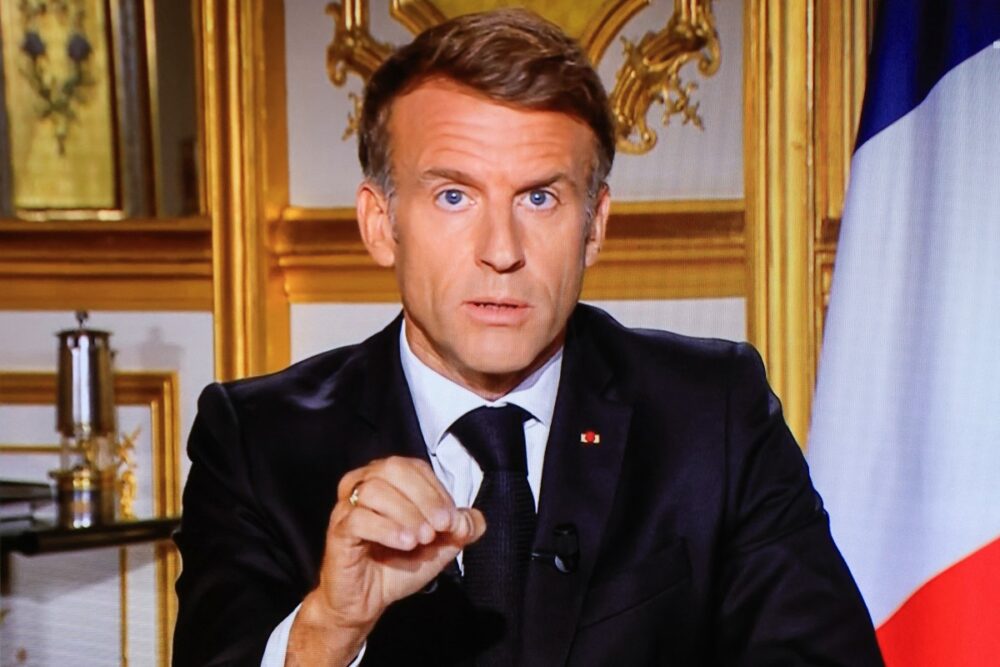
“We all feel tonight a sense of anger and shame,” said the President in a roughly ten-minute address broadcast Sunday evening, on the day after a day of disturbances on the margins of protests against “the high cost of living”, following several weeks of demonstrations in high schools.
Mr. Macron denounced “rioters from ultra-left fringe groups, joined by many delinquents”, who “have unleashed boundless violence in our cities.” But “we must never confuse” the protesters’ “legitimate demands” with “those who destroyed, broke, looted.”, he added.
The head of state also promised “transparency” regarding the order-maintenance strategy used on Saturday, asking the government and in particular “the Minister of the Interior” Laurent Nuñez to “draw all lessons” and saying he expects “clear answers”.
The executive is under heavy criticism, several opposition leaders calling for the resignation of the occupant of the Beauvau, the interior ministry. Even within the central bloc, where Édouard Philippe said he expected “answers” on the level of intelligence and the order-maintenance apparatus.
In the coming days, prefects “will make decisions” to “protect our cities,” including by going as far as prohibiting certain gatherings, announced the head of state, who is maintaining his three-day trip planned to the Middle East.
Condemn Without Ambiguity
Mr. Macron called on the “political parties”, but also on the “professional and trade union organizations to condemn violence unambiguously” and stressed the proximity of the presidential election, exactly six months away.
The violence around Saturday’s demonstrations led to 2,397 arrests, with 997 police and gendarmes injured including seven seriously, according to the latest figures from the Ministry of the Interior.
Bruno Retailleau, the Republicans (LR) candidate for the presidency, asked Mr. Macron to declare “the state of emergency,” “without delay.”
Jean-Luc Mélenchon (LFI) urged him not to “let the situation rot” and to respond to the protesters’ demands, because the youth “needs a good end to this sequence.”
No announcement regarding these demands (the fight against the high cost of living, the defense of public services…) has been made thus far by the head of state. But the Prime Minister will soon bring together political parties, unions, local authorities and parliamentarians in several meetings, he announced.
The epicenter of the Paris mobilization and Saturday’s clashes, Place de la République, was again the scene of confrontations on Sunday afternoon with the police, who used tear gas to disperse the crowd.
Stores were also looted in the district, where CRS 8, a unit specialized in fighting urban violence, was deployed for the second consecutive day.
On Saturday, the clashes and looting spilled over late into the night in several cities, reviving the heated debate about gaps in maintaining order, denounced notably by the mayors of Paris, Marseille and Limoges.
Outshining the concerns over purchasing power and youth malaise elsewhere, more than 30,000 looters were counted in the city of Marseille alone by the prefecture. The mayor Benoît Payan (DVG) had from Saturday “called to account” the shortcomings of the police deployment.
“We are living through a deep crisis of trust and authority, which threatens democracy,” said Marine Le Pen, candidate of the National Rally for the presidency.
Anger and Desolation
Mayors’ offices attacked, shops looted, streets littered with debris… In the many cities hit by the violence, the mood was one of assessment, desolation and sometimes anger. “It is lamentable, astonishing, packs of youths we saw here yesterday who looted and broke with impunity,” lamented Cécile Rogue, 57, in Paris.
The same feeling at Limoges’ town hall, devastated by flames. “My children got married here, it hurts my heart,” says Jean-Louis, a retired neighbor. “We can have demands without breaking everything.” About 7,000 people, including many elected officials, gathered Sunday in the city to express their emotion.
Across France, no fewer than 1,500 shops were targeted on Saturday, according to Alexandre Bompard, president of the Federation of Commerce and Distribution (FCD), estimating the damages at “several hundred million euros.”
Commerce Minister Serge Papin will convene Monday morning the federations representing merchants and distributors, hoteliers and restaurateurs, as well as banks and insurers.
Used to large-scale mobilizations, the country has already endured episodes of violence with the Yellow Vests in 2018-2019, the riots sparked by Nahel’s death in 2023, or protests against pension reform in the same year.
But Saturday’s day marks, according to some observers, a turning point.
Risk to the Nation
The mobilization was “bigger than expected”, forcing an adaptation of the “real-time arrangement.” The North prefect Bertrand Gaume acknowledged this.
A parliamentary inquiry commission on the violence will be created and will also address the strategy for maintaining order, announced Yaël Braun-Pivet (Renaissance), president of the National Assembly.
In the meantime, the Association of Mayors of France (AMF) called for gatherings Monday in front of town halls to alert to a “real risk for the entire Nation.”
The French crisis has not gone unnoticed abroad. “France is burning”, wrote American President Donald Trump, asserting that the country is “broken” by immigration.